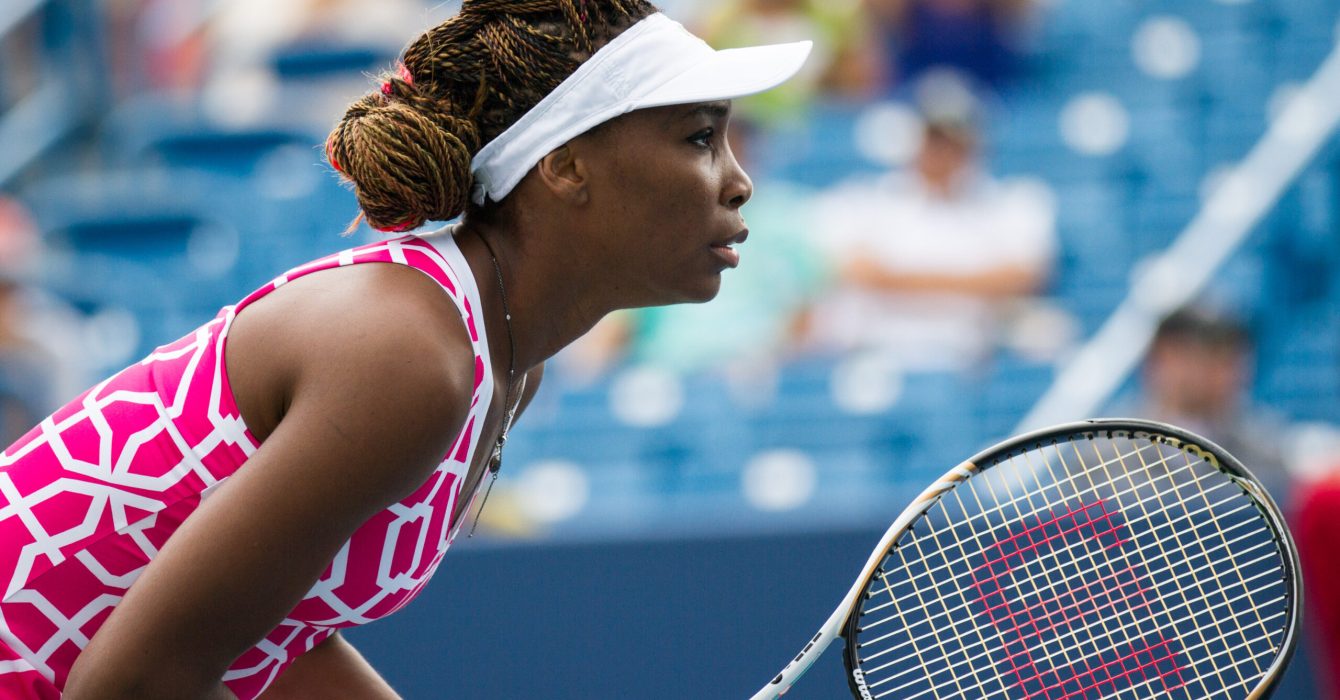
At 45, icon Venus Williams is competing at a level most professional tennis players have long since retired from. But how does she stay strong, resilient and match-ready? Here, we unveil her routine.
The average age of retirement for a tennis professional is 27, according to My Tennis HQ. Men tend to compete for longer, while women often peak earlier and retire sooner. Reasons commonly include chronic injury, financial pressures (less so for top-tier players) and, particularly for women, the decision to start a family.
Venus Williams, however — renowned for her powerful serve, powerful playing style and unwavering determination — defies all of this. At 45, she’s continued to stay firmly present on the professional circuit, most recently appearing at the Australian Open, becoming the oldest woman to ever compete in the tournament’s singles draw.
In her time, Venus has won 49 WTA Tour–level singles titles, including seven grand slam championships (five at Wimbledon and two at the US Open). While many of us might have called it a day after that, Venus continues to compete, often against opponents less than half her age.
Venus clearly demonstrates how powerful women in midlife can be but, the reality is that, as we age, factors such as reduced muscle mass, lower bone density, slower recovery and hormonal changes eventually cause fitness to decline.
So, what’s Venus’s secret? Beyond the obvious hours spent on the court, she follows a highly considered and holistic approach to training and nutrition. Here’s how she stays match-ready and what we mortals can realistically learn from it.
Read more: Hollie Doyle on how she got to the top of horse racing
View this post on Instagram
Venus Williams’ fitness regime
Court time
Unsurprisingly, Venus’s main workout is tennis. She often says that nothing can replace time on the court. Not just because she loves it, but because it’s the best way to stay sharp for her sport, working both her physical training and technical refinement.
Tennis works as high-intensity cardio while also improving endurance, agility, coordination, footwork and strength. Even for non-professionals, hitting the court or taking part in sport is a great way to seamlessly integrate cardio and skill refinement into your routine.
Strength and conditioning
While tennis keeps her agile and fit, Venus said in a 2024 interview that she also hits the gym to help maintain power, durability and injury resilience.
In the lead up to matches or tournaments, she reportedly spends just as much time in the gym as she does practising on court. Her workouts focus on controlled movements, including hip raises, banded leg exercises and core-centric moves such as weighted dead bugs.
Weight training is especially important for women in midlife: “Osteoporosis, bone and muscle atrophy become increasingly more common as you age, especially if you’re a woman,” says women’s health and menopause health expert Dr Shirin Lakhani. “Strength and weight training can prevent bone and muscle loss, as well as strengthen joints.”
Venus also told Women’s Health that she’s a fan of reformer Pilates, which helps with alignment and strength, and uses bosu ball exercises to improve balance and stability — essential for both good tennis game and general health and longevity.
Read more: Taylor Swift’s gruelling Eras Tour workout routine explained by fitness experts
View this post on Instagram
Plyometrics and explosive work
Venus has been known to incorporate plyometric, or explosive, exercises into her routine, as she revealed in a 2017 interview. Movements such as frog hops, squat tuck jumps and lateral bounds train muscles to generate maximum force in short bursts, helping to boost speed and power.
As Rosalia Padron Pol, head coach at F45 Training Camden, explains, explosive training helps “maintain fast-twitch muscle fibres, coordination and reaction time,” which are key for staying athletic and agile.
For professional athletes, she says, plyometrics enhance speed, power and resilience — “translating directly into better performance across sport and competition as well as preventing injuries.”
Venus is clear, though, that many explosive exercises are advanced and should be approached cautiously. For most people, simpler options like burpees or jump lunges can offer similar benefits without the same injury risk.
Rosalia agrees, adding that, for most people, an integrated approach — a mixture of power-based, plyometric and hybrid cardio sessions — is best. “These types of workouts challenge speed and coordination without overloading the body, improving athleticism in a safe, time-efficient way.”
Stretching and mobility
Despite the intensity of her training, Venus prioritises flexibility and mobility. In a 2023 Q&A, she explained that she regularly incorporates gentler practices, such as yoga-style stretching, to keep her joints healthy and muscles supple — and has even been seen on Instagram joining her sister Serena Williams for live yoga and stretching sessions.
Before this, in a 2019 interview with CNBC, she said she stretches for up to 30 to 45 minutes whenever possible, explaining that it helps her body recover and releases endorphins, boosting mood. Hip and hamstring mobility, in particular, are key parts of both her warm-ups and cool downs — something anyone can adapt to support longevity and ease of movement.
As the body ages, mobility work is key for keeping joints healthy, improving recovery and reducing injury risk. And for athletes like Venus, this regular stretching and yoga is surprisingly essential, because it “supports movement quality, helps manage training load and allows them to train harder, for longer and more consistently,” says Rosalia.
Recovery
Training at Venus’s level demands a commitment to rest. In 2024, she told Women’s Health that recovery is just as important as training itself, particularly when it comes to preventing injury and sustaining energy levels.
Sleep is a top priority: she told CNBC aims to get at least eight hours a night, tries to be asleep by around 11.30pm and avoids staying up past 1am.
Read more: Made to Move: Everything you need to know about strength training as a woman

What does Venus Williams eat?
Plant-based diet
According to sources, Venus follows a mostly plant-based diet — a choice she made partly due to being diagnosed with Sjögren’s syndrome, an autoimmune condition that can cause joint pain and fatigue.
She says this way of eating helps manage her symptoms, but it’s also great for sustaining energy and aiding recovery. That said, she remains flexible, allowing for occasional indulgences and meat dalliances.
Indeed, a plant-based diet can be especially useful for women in their mid 40s and during the perimenopause, by helping “manage symptoms like poor sleep, mood changes and hot flushes,” says Natalie Rouse, in-house nutritionist at Free Soul.
To maximise the benefits of a plant-based diet, Natalie suggests prioritising whole foods that are high in fibre, antioxidants and phytoestrogens from soy, flaxseeds and legumes.
Protein intake
As Venus is plant-based and an athlete it means protein is a priority. She told CelebWell she gets hers from plant-based proteins, such as chickpeas or soy products, and she’s also spoken about relying on protein shakes during heavy training periods, especially after a high-intensity session when her appetite is low but the need for recovery is high.
In 2020, Venus launched her own vegan protein brand, Happy Viking, which she regularly incorporates into her routine.
Intermittent fasting
In her day-in-the-life exclusive with Us Weekly, Venus divulged that she practices intermittent fasting, eating her first meal around midday and finishing dinner between 6 and 7pm.
A 12- to 16-hour overnight fast can help with recovery, lean muscle preservation and managing her symptoms, as well as being flexible enough to fit around training demands.
In many cases, for women in midlife intermittent fasting may improve insulin sensitivity and cellular repair. Though, as Natalie warns, benefits depend on nutrient timing and adequate intake: “Poorly structured fasting can compromise protein, micronutrients and muscle mass, especially during perimenopause.”
There’s still some debate around whether intermittent fasting is good for women, so it should always be approached with caution and, ideally, only after seeking medical advice. But if you do choose to adopt this diet, Natalie suggests breaking your fast with a “protein-rich, fibre-containing meal to support muscle, blood sugar and hormone balance.”
Read more: “I’ve been a vegetarian for six years — here’s how I hit my protein goals”
View this post on Instagram
Limiting sugar
To support her immune system and reduce inflammation, Venus limits refined sugar, as she told The Sports Rush in 2024. But she still includes naturally sweet foods like fresh berries, often in smoothies, which she regularly breaks her fast with.
While cutting out all sugar altogether isn’t necessary for good health, Natalie says reducing your intake can help “support stable energy, balanced hormones, reduced inflammation and slow glycation, which protects collagen and elastin.” Plus, Perimenopause can heighten cravings, making low-sugar strategies especially helpful.
So, what’s the biggest takeaway from Venus Williams’ approach?
While the finer details of Venus’s training and nutrition — such as timings and frequency — aren’t fully public, the foundations of her approach are clear: consistency, recovery and listening to her body.
Although her workouts are intense and designed to keep her at an elite level, longevity, not punishment, is the priority.
And while few of us are training for Grand Slams — or could realistically keep up with a routine like this — it’s reassuring to know that even at Venus Williams’ level, success is built not just on discipline, but balance, self-care and tuning into your body.
Feature image: Flickr