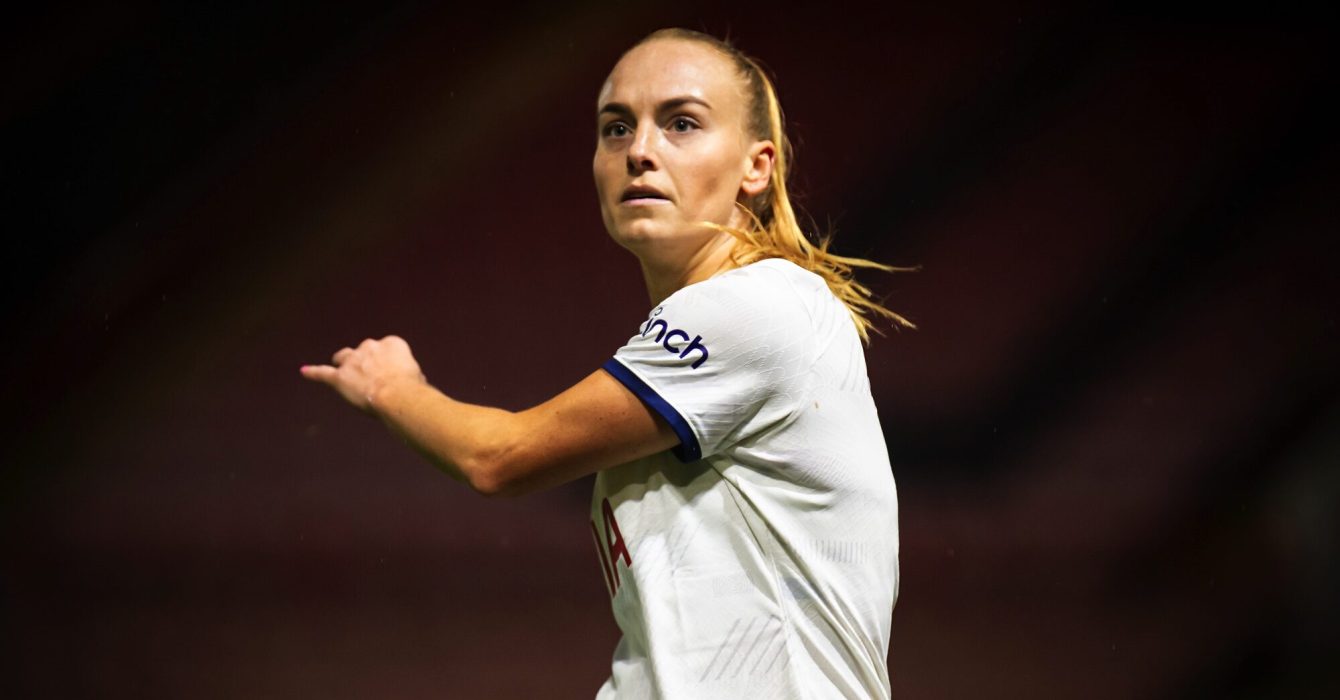
Campaigners argue that the quality of clinical treatment for anorexia is failing those struggling. Speaking exclusively with Living360, Tottenham Hotspur Women’s defender Molly Bartrip shares her experience.
Molly Bartrip is at the top of her game. A defender for Tottenham Hotspur Women’s team and formerly Arsenal, she’s well on her way to an incredible football tenure. But before she was manoeuvring on Premier League pitches, she was fighting a very different battle — one that nearly cost her everything.
At age 15, Molly developed anorexia nervosa, a highly dangerous eating disorder characterised by an intense fear of gaining weight, extreme food restriction and distorted body image. Disconcertingly, and a surprise to many, it currently carries the highest mortality rate of any psychiatric disorder globally.
For Molly, the disorder came as a complete surprise. She grew up in a supportive, happy home, thriving in elite football and representing England at U15s. But one event — not being selected for an international camp — set off a devastating chain of events.
“I went from being a bubbly, outgoing teenager to someone who hid themself,” says Molly. “I felt rejected, not good enough and completely lost.”
View this post on Instagram
At first, she simply started eating less. As an athlete, no one noticed at first: “People assumed I was just trying to get fitter, so I got away with it for a while.”
But when a friend confided in her mum that they had seen Molly throwing her lunch away, her family noticed her weight dropping drastically, and everything changed. “I wasn’t trusted to eat lunches at school anymore,” she says. “And I wasn’t allowed to play football.”
What causes anorexia?
There’s no one single cause for any case, but specialists believe anorexia develops through a combination of genetic, psychological and environmental factors.
Certain environments may increase the risk. For instance, there’s a higher prevalence of eating disorders in high-pressure academic schools and elite sport settings. There’s also a growing overlap in cases of anorexia and neurodivergence — thought to be due to things like sensory sensitivities, fullness cues and emotional regulation.
In Molly’s case, the trigger was emotional, a response to not feeling good enough. “I punished myself by not eating,” she says. “I thought it would make me feel better.”
Feelings of rejection, low self-esteem, trauma or significant life changes are commonly reported by those who develop anorexia.
Other factors, such as growing up in a household where dieting is normalised or appearances are frequently commented on or scrutinised — whether in well-meaning ways or not — can also contribute.
Of course, not everyone exposed to those experiences becomes ill. Dr Joanna Silver, specialist psychologist at Orri, finds it helpful to think of eating disorders as triggered when a vulnerable individual (meaning someone who is vulnerable to developing them) is “in the wrong place at the wrong time.”
Read more: Olympian Ellie Downie on quitting gymnastics for the sake of her mental health

How is anorexia treated?
Campaigners argue that care in the UK is inconsistent and inadequate; some delivered a petition to Downing Street in October 2025 calling on the government to do more to prevent avoidable deaths from eating disorders.
But despite their severity, eating disorders are “notoriously under-researched” compared to many psychiatric illnesses, says Dr Lorna Richards, consultant psychiatrist at the Priory Group. And this deficiency in understanding only compounds the uncertainty around their cause and limits effective strategies for treatment.
Care typically combines psychological therapy, such as Enhanced Cognitive Behavioural Therapy (CBT-E), with supervised weight gain, while more severe cases may require day programmes or inpatient admission to stabilise physical health.
Still, outcomes are precarious. According to Dr Lorna, even the best treatments bring about significant improvement in just half of patients, with 20% remaining severely ill and remission rates high.
Why is anorexia so difficult to treat?
Even to clinicians, it’s a uniquely perplexing condition.
For someone with an eating disorder, thoughts are ‘ego-syntonic,’ meaning they’re experienced as part of the self and aligned with a person’s values and goals. The idea of treatment, then, feels incongruent with or even a threat to that person’s sense of self.
Resistance feels like the safest and most logical reaction: “If someone feels their eating disorder is helping them cope, asking them to give it up can feel frightening,” Dr Joanna explains.
And if the illness first develops in adolescence, at “critical developmental stage, when identity formation is key” it’s even harder to give up that “anorexic identity”, says Dr Lorna. “There’s no clear alternative or ‘authentic self’ to turn to.”
Read more: Gen Z are facing a mental health crisis in the workplace — this is what they can do

Illness as a coping mechanism
In some cases, the disorder may begin as an attempt to meet social expectations or feel seen. In others, like Molly’s, it was a way to manage emotional pain. But how can something so harmful be helping someone cope?
When the body feels a shift like this, it tips into survival mode. The mind calms down, and the internal chaos settles into something that feels safer. “It can help numb overwhelming emotions,” explains Dr Joanna.
The illness serves a purpose. What others might see as a problem, the person with the eating disorder often views as a solution.
To an outsider, this can seem like the individual ‘doesn’t want to get better’, but the reality is far more complicated. Even when the person desperately wants to, they feel stuck, unable to see a way out. They’re grappling with long-established behaviours and beliefs that are deeply rooted in whatever they gain from the illness — control, their sense of identity, social acceptance, values, goals.
Which is why “understanding what the person gains from the illness is crucial to treating them effectively,” says Dr Joanna.
Read more: Adele Roberts on completing seven major marathons with a stoma bag: “I won’t let it change me”

One of Molly’s biggest obstacles was accepting how unwell she was. “I saw a counsellor, but I didn’t believe it was helping,” she says. “I was convinced I was fine.”
But when her physical health deteriorated, eventually her parents took her to the hospital. Although her BMI didn’t fall below her age group threshold to require tube feeding, she came close, and the warning was stark.
“It was a wake-up call,” Molly recalls. “I didn’t realise how bad I actually was.”
Fortunately for Molly, she had a powerful motivator in football — a dream that proffered a better future. “When I play, I feel free,” she says. “I wanted to get back on the pitch, I wanted to make it.”
Molly has now rebuilt her life and she’s proud of how far she’s come. Her message is powerful — recovery is possible: “I promise you, if I can fight this illness, you can too.”
But progress is rarely linear. No two experiences are the same; no two treatments are the same. Anorexia is complex and insidious — not being able to recover is by no means a lack of strength or resilience.
What’s the future of anorexia care?
Progressing policy, funding and research are crucial for better outcomes. And for Dr Lorna, the first step is reducing stigma. “It shouldn’t be this way, but stigma has a pernicious impact on investment in research and clinical services,” she says. “Spreading awareness that eating disorders are not self-inflicted, unserious or under the control of the person is vital.”
Read more: Former Lioness Fran Kirby is calling for women to prioritise their heart health — and this is why
View this post on Instagram
For Molly, prioritising unfiltered conversations around anorexia is paramount, and she hopes her efforts will help others realise that education is critical — particularly in schools and sporting environments. She regularly speaks publicly about her struggle, even telling her story Ana as part of the book I’ve Got A Story To Tell by The Player’s Tribune (£100).
“Eating disorders are often about hiding,” she says. “The more awareness there is, the healthier environments will become. Paying attention to those around you is crucial.”
If you think you or someone you know may be struggling with an eating disorder, speak to a GP as soon as possible or contact Beat, the UK’s eating disorder charity, for confidential support.
Feature image: Flickr/ Molly Bartrip